
Columbia Projected Versus Actual Release
A projected date is a calculation based on the records and legal conditions known at a point in time. An actual release date records an event that already occurred. A date can also mean parole eligibility, release from prison into supervision, maximum sentence completion, or final discharge. Those points must not be collapsed into one label.
A Columbia County pretrial detainee has no normal sentence-complete calculation. Bail may be posted, charges may be resolved, or a court may issue a release order, yet other dockets and holds can delay the physical exit. A county-sentenced person’s computation depends on the judgment, confinement credit, and county records. A state prisoner’s calculation belongs to PA DOC and the sentencing court.
- Minimum
- The usual first point when parole may be considered, subject to law and eligibility.
- Maximum
- The end of the controlling sentence calculation, subject to lawful changes.
- Release
- Exit from a particular custody, sometimes into supervision or another agency.
- Discharge
- The later end of the sentence or supervision obligation.
Find Columbia County Release Dates
Pennsylvania’s public Inmate/Parolee Locator does not publish a verified future projected, tentative, minimum, maximum, parole-eligibility, or sentence-complete field. The Department Supervised Individual mode can show a field called Release Date. That is a past date tied to release from DOC incarceration into current supervision. It must not be used as a future forecast or final discharge date.
The official PA DOC locator search form is shown in this captured source.
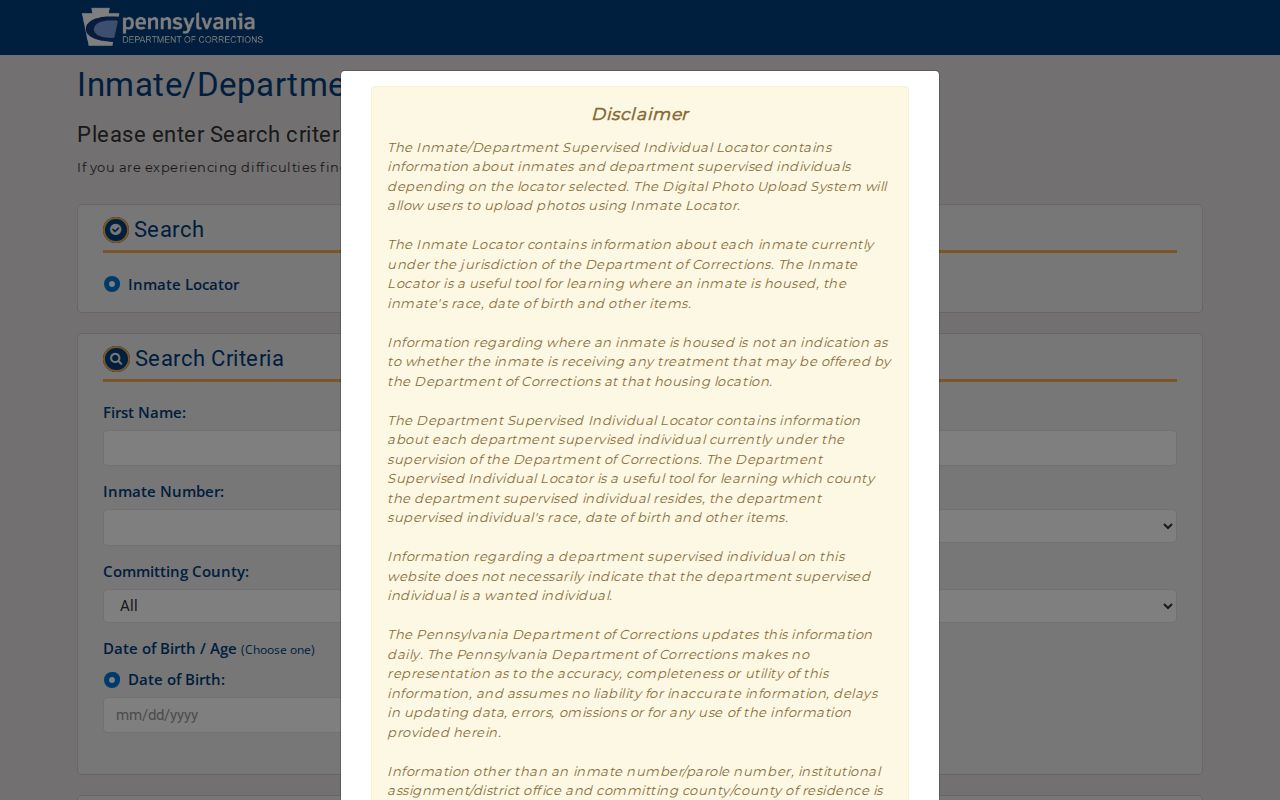
The capture helps identify the correct statewide service, but its public result fields still do not supply the future date sought here. For a future state calculation, obtain the sentencing order and an authoritative DOC sentence-status record. DOC policy identifies Sentence Status Summaries, sentence-computation printouts, Sentence Status Change Reports, release worksheets, release orders, conditions, and Board Actions. Not every internal document is guaranteed public, but those names help frame a precise records request.
- Identify whether the person is pretrial, county sentenced, state sentenced, or already on supervision.
- Find the Columbia County docket and sentencing order through UJS Case Search.
- For county custody, ask Columbia County Prison Records at 570-389-5718 for the existing commitment, computation, or release record.
- For state custody, request the current DOC Sentence Status Summary or computation through the proper records route.
- Check the latest Board Action and all detainers before treating a date as likely.
- Confirm physical release from the later release worksheet, movement record, or direct custodian report.
The broader Columbia County released inmate search helps identify the correct custodian after the projected date has passed. DOC’s Records Office Operations policy supplies useful document vocabulary. DC-16D and DC-16E are Sentence Status Summaries. DC-23B is a Sentence Status Change Report. The policy also identifies the DC-158 Release Worksheet, Department Release Checklist, PBPP-10 and PBPP-11 release orders and conditions, and PBPP-15 Notice of Board Action. Naming the needed record is more precise than asking an office to calculate “the date” from scratch. Request the current version and the related order that caused any change.
Columbia Sentences and RRRI
Pennsylvania has no verified universal rule requiring every state prisoner to serve 85 percent of the maximum or imposed sentence. Federal shorthand must not be imported into a Columbia County state case. Pennsylvania generally uses a judicial minimum and maximum plus discretionary parole. Under 42 Pa.C.S. § 9756, a sentence of total confinement generally states both terms, and the minimum normally may not exceed half the maximum, subject to exceptions. The minimum is ordinarily the first point for parole consideration. Under 61 Pa.C.S. § 6137, the Board may parole an eligible person after the minimum, subject to its authority and restrictions. Reaching that point does not guarantee a grant or prompt exit. Life and death sentences lie outside ordinary parole authority, and some offenses or sentence types have special rules.
The percentage-based state mechanism relevant here is Recidivism Risk Reduction Incentive, or RRRI. A sentencing court determines statutory eligibility. Under 61 Pa.C.S. § 4505, an eligible ordinary minimum of three years or less yields an RRRI minimum equal to three-fourths of that minimum. If the ordinary minimum exceeds three years, the RRRI minimum is five-sixths. Those rates are 75 percent and about 83.33 percent, not 85 percent, and they apply to the minimum rather than the maximum.
Eligibility is restricted by § 4503, including exclusions tied to listed offenses and circumstances. Program completion or conduct does not create a universal automatic subtraction. Use the sentencing order and DOC RRRI guidance, not a generic calculator. RRRI timing also depends on the exact ordinary minimum and any consecutive-sentence aggregation. Partial days round as the statute directs. A web calculator that ignores aggregation, court eligibility, or statutory exclusions can produce a plausible but wrong date. Even an accurate RRRI minimum is an incentive eligibility point, not proof of favorable release action. The Board and DOC processes still control the next steps.
Note: RRRI is a state-DOC path, not a general discount for a Columbia County Prison sentence.
Why Columbia Release Dates Change
A correct computation can change when the underlying legal or record facts change. The latest authoritative record controls. Even when the numerical date stays fixed, the person may remain confined while release conditions or a receiving agency are resolved.
| Factor | Possible effect | Best record |
|---|---|---|
| Confinement credit | Corrects time already served | Sentence computation and court order |
| Corrected commitment | Changes the term DOC must calculate | Amended judicial order |
| Consecutive sentences | Aggregates controlling terms | Sentence Status Summary |
| RRRI status | Adds an eligible incentive minimum | Sentencing order and DOC record |
| Parole grant or refusal | Affects possible release after minimum | PBPP-15 Board Action |
| Recommitment | Can alter time calculations after parole action | Board and DOC computation records |
| Detainer or other sentence | Can prevent community release | Hold, warrant, or receiving-agency record |
A grant may include an approved home plan, program, paperwork, or other condition. The person can remain confined while staff confirm those requirements. A release to another custodian also ends one confinement without ending all custody.
The maximum or sentence-complete date can also be misunderstood. It is the end of the controlling judicial sentence calculation, not necessarily a public locator field or the date a family member can infer from a news report. Credit corrections, amended commitments, aggregation, and parole recommitment can change the record. When two official documents conflict, ask the record-owning office which is current and what later order or status report superseded the older version.
Parole decisions and release transactions happen at different stages. Board factors can include the offense circumstances, recommendations, institutional conduct, history, and other statutory material. A refusal leaves the person confined subject to the governing sentence and any later review. A grant authorizes a path toward release but can remain unexecuted. The PBPP-15 states the decision; the release worksheet or movement record shows whether the planned release actually occurred.
Confirm Columbia Actual Release
Use a clear evidence order. First, the sentencing order establishes the imposed minimum and maximum and any RRRI finding. Second, DOC’s current Sentence Status Summary or computation reflects the agency calculation. Third, the Board Action states grant, refusal, or another review action. Fourth, a release order, worksheet, or movement record documents the actual transaction. Fifth, a supervised-person result’s past Release Date can corroborate release into state supervision. Finally, a sentence-complete or discharge record confirms the later end of the sentence.
PA SAVIN can provide a rapid notification for a participating county or state event. Register through the Columbia County VINELink check, but do not substitute an alert for a release record. SAVIN can report movement as well as release, and its data can lag. Call the responsible prison or DOC office when timing matters.
For Columbia County Prison, distinguish the main line, Records, court docket, and supervision office. The jail record reports the physical custody event. The docket reports the legal authority. County Adult Probation and Parole reports county supervision within disclosure limits. State DOC and the Parole Board handle state cases.
After the expected day passes, identify the event that actually occurred. Community release, release into parole supervision, transfer, and full discharge are different outcomes. Ask for the transaction date, movement code, and destination when those fields exist. If DOC supervised mode later displays a past Release Date, compare it with the release worksheet and last-updated time. That check avoids treating a delayed web update as proof that a planned event failed.
Columbia County Sentence Caution
Columbia County Prison can hold people serving county terms, but its official website publishes no release-date calculator, local good-time manual, or future-date web field. Pennsylvania law provides county-parole mechanisms, yet the named case still turns on the court’s order, confinement credit, prison computation, and any county parole order. Do not apply state RRRI percentages to a county jail term.
A focused request can seek the existing commitment record, sentence computation, release order, or release record for the named person and date range. The Right-to-Know Law does not force an agency to create a fresh calculation or answer a general question. Access may also be limited by other law, privilege, sealed status, or protected information. Ask for existing records and accept lawful redactions.
If the county sentence ends but a detainer remains, the person may transfer rather than go home. The receiving-agency field, when recorded, is as important as the date. It explains whether the projected exit from Iron Street became community release or a move into state, federal, immigration, or another county custody.
A records response can be partial. Pennsylvania’s access law permits withholding or redaction when another statute, privilege, or exception applies, while favoring release of nonexempt portions. Ask for the date fields, record title, and transaction code that can lawfully be provided. If the office denies access, read the cited basis and appeal route rather than substituting an unofficial estimate. Exact sentence computation can affect liberty and should remain tied to the responsible court and corrections records.